
NDIS mandatory registration changes: What July 2026 means for your business
Written by Amanda Watson · Co-Founder TrustBook · Founder, Audit Hub · 10+ years NDIS compliance experience
Last updated: June 2026 · Reading time: 5 minutes
Summary
- From 1 July 2026, all Supported Independent Living (SIL) providers must transition to mandatory registration.
- Registration requires meeting the new SIL Practice Standards (plus the Core Module) and undergoing an audit.
- Registration via the certification pathway typically takes time – get started now.
- Providers currently delivering SIL in an unregistered capacity will be expected to have commenced the registration process by 1 July 2026.
- Unregistered providers must have lodged an application by 1 October 2026 to keep delivering SIL.
What changes are coming to mandatory registration in July 2026?
From 1 July 2026, Supported Independent Living (SIL) comes into scope for mandatory registration.
From 1 July 2026 the mandate takes effect, updated certificates will be issued, and the new SIL Practice Standards apply.
From 1 October 2026 a penalty threshold begins: delivering SIL without a registration application in progress becomes a serious offence, carrying a maximum penalty of two years’ imprisonment, a fine of 120 penalty units, or both.
Who is affected by the July 2026 changes
This is a significant shift, bringing thousands of currently unregistered providers under the full NDIS regulatory framework for the first time.
Supported Independent Living (SIL) providers
SIL covers residential supports delivered to participants who live in shared or individual accommodation with ongoing support needs. If your organisation provides SIL as a service, you are in scope from 1 July 2026.
Not sure whether what you deliver counts as SIL? The distinction turns on how much support is provided and who directs it. You are likely providing SIL if a participant requires support at all times of the day, or for most of the day; if your organisation manages and delivers that support in line with the participant’s package of supports; and if the assistance helps the person live in their home as autonomously as possible and access the community by assisting with or supervising daily life tasks. You are likely not providing SIL if a person receives only a few hours of support a day or week, or if the participant chooses and manages their own support workers, including directing, planning and rostering them.
Today, SIL sits within registration group 0115. From 1 July 2026 the Commission moves SIL into a new dedicated group, 0138.
Short Term Accommodation (STA), Medium Term Accommodation (MTA) and Individualised Living Options (ILO) remain in group 0115, where registration stays optional.
SIL is a certification pathway group, meaning you will need to undergo a full certification audit (a face-to-face audit) rather than a desktop verification. For most SIL providers who are not currently registered, this will likely require an operational review to understand the implication of the change.
See our short video detailing these changes, here.
What registration involves
For providers approaching NDIS registration for the first time, the scope of what is required often comes as a surprise. Registration is not a form you fill in. It is a formal assessment of your organisation’s governance, systems, policies, and practices against the NDIS Practice Standards.
The certification process involves:
- An online application that includes a self-assessment against the relevant NDIS Practice Standards modules
- Engagement of an Approved Quality Auditor (AQA) from the NDIS Commission’s approved list
- Development and documentation of your compliance framework, including risk management, incident management, workforce screening, complaints handling, participant rights, and governance
- A formal site audit including participant and staff interviews, file reviews, and observation of your operational practices
The specific Practice Standards modules you will be assessed against depend on your registration groups, but for SIL providers, expect assessment across the Core Module and the new SIL Practice Standards, which apply from 1 July 2026. These standards introduce four outcomes built for the realities of SIL settings:
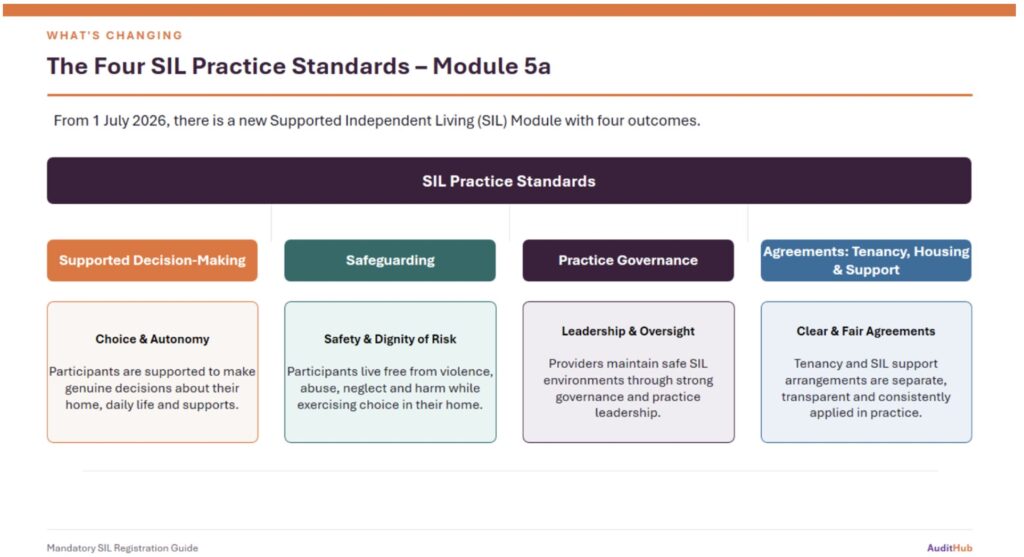
An NDIS certification audit is not jus testing whether you have documents and policies. It is testing whether your documents reflect how your organisation actually operates, and whether your staff understand and follow your systems. A policy suite purchased off the shelf and never embedded in practice will not pass a certification audit. The preparation that matters most is operational, not administrative.
How long does registration take, and why you need to start now
The certification pathway, which applies to SIL providers, takes adequate preparation, must factor in auditor (AQA) availability. In practice, many providers find the process takes months, not weeks.
Providers currently delivering SIL in an unregistered capacity will be expected to have commenced the registration process by 1 July 2026.
The transition period has no published end date, though unregistered providers must have lodged an application by 1 October 2026 to keep delivering SIL.
The NDIS Commission maintains a limited list of Approved Quality Auditors (AQAs), and as thousands of SIL providers move simultaneously into the registration process, audit appointment waitlist times are likely to extend. Providers who delay AQA engagement risk being unable to secure an appointment before the transition window closes.
Your next steps
The next steps you take depend on where you are in the process.
If you have not yet started your registration application
Begin immediately. Three things to do first:
- Review your current group 0115 services against the SIL definition above to confirm what is in scope.
- Familiarise your operations with the NDIS Practice Standards including the new SIL Practice Standard.
From there, log onto the NDIS Commission Applications Portal and complete your application. Then engage an AQA to conduct your audit.
If you have started your application but are mid-process
Check your current timeline against the stage breakdown above. If your document preparation is not complete, it is the most urgent bottleneck. Prioritise your incident management, risk management, workforce screening, and governance frameworks. These are the areas auditors assess most rigorously in certification audits.
If you are registered and your services include SIL
If you already hold SIL registration, your registration status does not change on 1 July 2026, but the new SIL Practice Standards will apply to you, and how they are assessed depends on where you sit in the audit cycle:
- If your audit was completed before 1 July 2026, you will be assessed against the new SIL Standards at your next scheduled midterm or recertification audit.
- If an application for re-registration is in progress from 1 July 2026, your unfinished audit will be assessed against the new SIL Standards straight away.
- If a midterm audit is scheduled between 1 July and 31 December 2026, the Commission will intervene, revise your audit date, and send you a new schedule.
If you are unsure whether you are affected
Seek a formal assessment. The consequences of getting this wrong, either registering unnecessarily or failing to register when required, can carry compliance costs. An experienced compliance advisor can give you a definitive answer based on your service model and registration groups. You can also reach the NDIS Commission directly on 1800 035 544 (Monday to Friday), at registration@ndiscommission.gov.au, or at ndiscommission.gov.au.
Ready to act?
You don’t have to do this alone.
TrustBook is a full compliance platform built for NDIS and Aged Care providers, with compliant policies and procedures, governance registers and audit-readiness checks tailored to your business.
Need expert advice?
AuditHub, a proud partner of TrustBook, adds the human-centred support: advisors who guide you through every step, from confirming your registration groups to audit readiness.